Building Global Connections at the 2026 SummerSchool
The extreme heat during this year's DigitalGreenTalents Summer School demonstrated why the global exchange of ideas is so urgently needed: It took place during a severe heatwave, and the hottest June on record in Western Europe. In these unusual circumstances, a group of 30 young scientists from Germany and around the world came together to present their research, share ideas, learn from each other and interesting speakers and above all: build connections.
Berlin, 29 June 2026 – The Summer School forms part of the Digital GreenTalents Award, which recognises twenty young researchers from different countries and scientific disciplines each year for their work at the intersection of digitalisation and sustainability. Selected by a jury of experts, the awardees receive a three-month research scholarship in Germany and the SummerSchool. This year, they were joined by ten GreenMinds – young researchers already based in Germany who use digital tools to study sustainability and applied to take part in the SummerSchool.
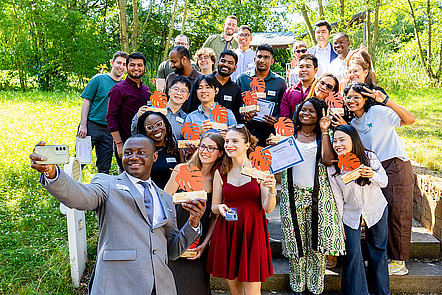
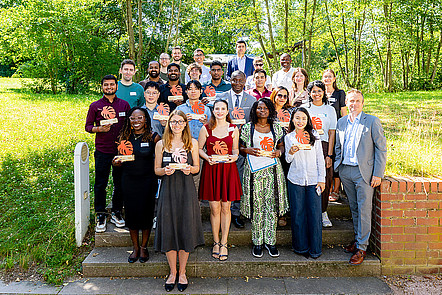
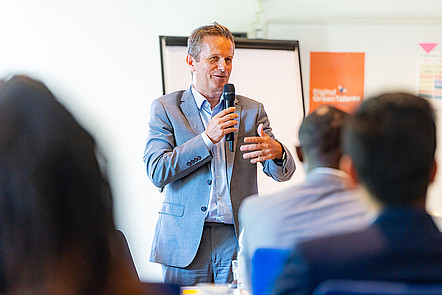
For the second time the event took place in Steinbach, a rural setting with views of the Frankfurt am Main skyline. The week opened with an Award Ceremony, where Dr. Rainer Müssner from the Federal Ministry of Research, Technology and Space presented the Digital GreeenTalents 2025 with their awards and in his opening speech emphasized the importance of a strong international network for a successful career.
Over the following days, the programme covered lectures on climate models, the circular economy, AI in Digital GreenTech, career paths in Germany and many more. In the middle of the week a field trip took participants to pioneering sites including EmergenCity at TU Darmstadt, Fraunhofer IGD and Industriepark Höchst. And the evenings brought plenty of opportunities to connect: from a Germany quiz and a visit to a local restaraunt in Frankfurt to a round of beach volleyball. The programme was complemented by workshops in which participants exchanged research ideas within five research disciplines: climate change mitigation, energy technology and systems, smart cities and regions, water and land use, and circular economy alongside further sessions on entrepreneurship and science communication.
In his session, science communicator Christian Scharun reminded participants that communicating their work to a wider audience can also advance their scientific goals, citing research that linked social media sharing of their research to more citations. He also raised a broader question: whose achievements get recognised, and which stories get told? As an example, he pointed to Eunice Newton Foote, who demonstrated the greenhouse effect in her home laboratory as early as 1856, before it even had a name. Yet, it is Irish scientist John Tyndall, who later explained the mechanism behind it, who is widely credited today as its discoverer. Participants could then practice ways to communicate their own research topics more compelling to a wider audience.
On Monday and Friday, alumni of the earlier GreenTalents programme came to Steinbach to share their career paths and research. Among them was Yauheniya Shershunovich, GreenTalent Alumna of 2018 and Associate Academic Officer at the United Nations University in Bonn, who led a workshop on "Beyond GDP." She traced the history of GDP as a measure and introduced participants to the international research and policy agenda seeking to complement or move beyond GDP as the dominant measure of societal progress – recognising that well-being is multidimensional.
The week closed with a barbecue night with a music quiz and on Saturday participants set off back to their research stays across Germany or to their home countries – taking with them not only new knowledge and ideas, as well as a network of contacts that they can call on to create cross-border collaborations in this urgent field of research that our world needs more than ever.